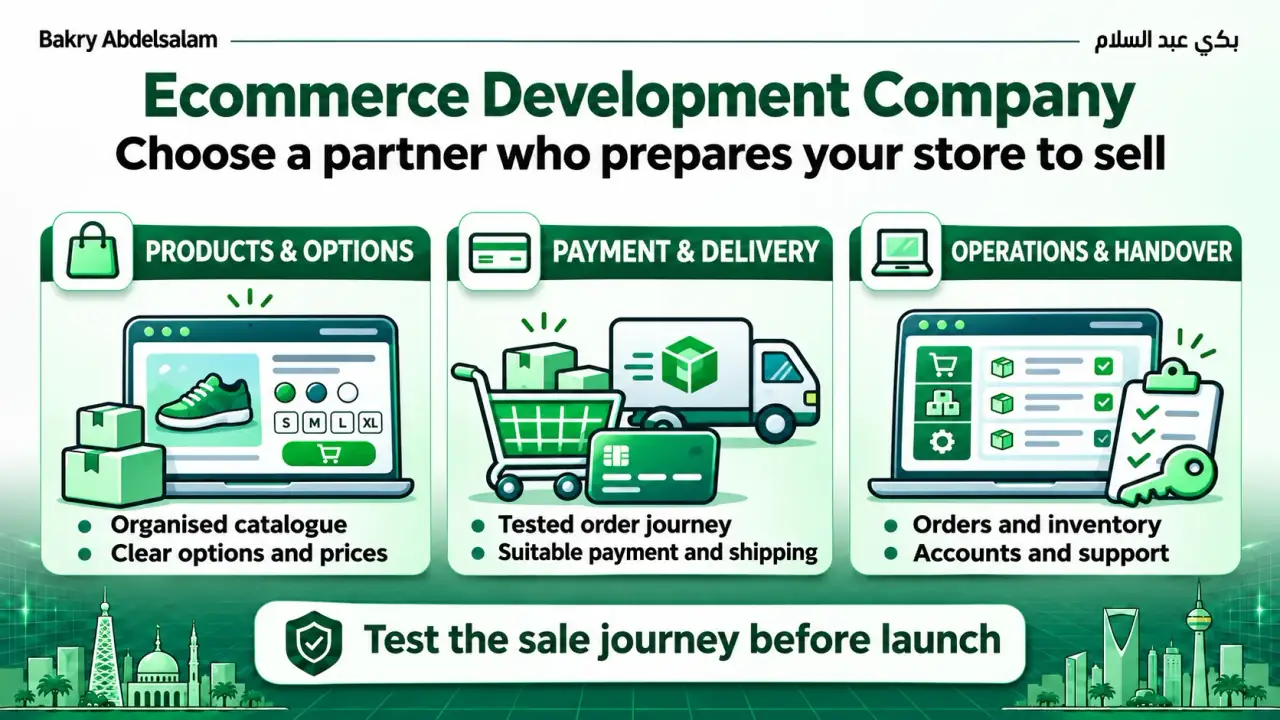
A polished product page may attract attention. The sale still stops if a shopper cannot understand the available options, see delivery costs or recover from a failed payment. Choosing an ecommerce development company should therefore start with the buying and operating journey your store needs.
If you are searching for the best ecommerce website development company, ask each candidate how a customer will purchase, how your team will fulfil the order, and what you will pay to operate the store after launch. Those answers make proposals much easier to compare than home page designs alone.
I am an independent developer building WooCommerce stores. This guide uses decisions from real work, while recognising that a hosted platform or a larger development team may suit some businesses better. It is a selection framework, rather than an agency ranking or a claim that every store needs custom development.
The short answer: ask for a complete order journey
Evaluate a provider against a sample from your own catalogue: choose a product and its options, add it to the cart, apply an address and delivery method, test payment, and review the resulting order in administration. Include stock handling, recurring costs and business account ownership in the discussion.
When comparing ecommerce website design companies, ask who will implement the checkout and integrations as well as design the pages. If different people handle those tasks, establish who is responsible for resolving a problem that crosses between them.
If you are preparing to build, review my ecommerce store development service. Bring representative products, markets, languages and operating requirements so we can assess the scope before committing to a platform.
How to choose an ecommerce developer for your catalogue
Product count is an incomplete estimate of the work. A simple catalogue may be easier to prepare than a smaller set with many combinations, different stock rules or special delivery requirements.
Send three examples: a straightforward item, a product with options, and an exception that changes pricing or fulfilment. Include the descriptions, images, variations, prices and stock information you have. Explain whether the provider must clean up a spreadsheet, enter products manually or train your team to do the work.
A decision from Raphia: coffee weight, grind and brewing method mattered to discovery and product selection. The Raphia WooCommerce case study explains the relationship between the brand story, product routes and Arabic and English store journeys. If your catalogue has similar choices, ask to see those choices working before approving the catalogue template. The example demonstrates delivery decisions, not an invented sales uplift.
Select the platform around operations
Start with what staff need to do, the payment and delivery services required, and any systems that must connect to the store. Ask what can be exported if you change providers and which services would need to be configured again.
| Approach | When to investigate it | What to verify |
|---|---|---|
| Hosted platform | Its available features cover your operation | Plan limits, applications, design flexibility and data export |
| WooCommerce | You need WordPress management and suitable customisation | Hosting, extensions, updates and maintenance responsibility |
| Custom development | Important workflows are not covered by an appropriate existing solution | Build cost, testing, documentation and continuing engineering |
These are starting points for evaluation rather than universal recommendations. Ask each provider to explain why its proposal fits, including whether a simpler setup would meet your current needs. The WooCommerce, Shopify and Salla comparison explores that separate platform decision.
Separate integration work from merchant approval
A developer may configure a payment integration, but the payment provider controls approval and activation of your merchant account. Establish what the developer supplies, what you must submit directly to the provider and which scenarios can be tested before activation.
For delivery, specify supported areas, rates, exceptions, stock locations if relevant, and who updates order status. Selling to Egypt and Saudi Arabia may involve different currencies, provider accounts and delivery rules. Do not assume one configuration covers every market; identify the exact journeys to be implemented and tested.
For a Saudi focused project, review ecommerce development for Saudi Arabia. Confirm provider eligibility and any business obligations with the relevant providers and advisers. A working store interface does not establish that merchant approvals or regulatory responsibilities are complete.
Require order tests before accepting the store
Agree a shared review on a staging environment, using test details and the methods supported by the payment provider. WooCommerce documents order testing and warns that test orders can trigger emails and connected services. Keep test activity separate from real fulfilment and follow the instructions for each integration.
Your acceptance scenarios can include:
- Select an option and check that the correct price and stock reach the cart.
- Enter an eligible delivery address and an excluded address, then inspect the rates and message.
- Exercise successful and failed payment scenarios supported by the provider.
- Confirm the customer message and order status reach the expected destinations.
- Review an order change or refund using the agreed permissions and operating process.
- Have the person running the store update a product and its stock.
Review the main journeys on a phone and in every commissioned language. Record any unresolved issue and its owner before launch. A completed set of pages is a useful milestone, but it is not the same as demonstrating the operating journey.
Compare a year of operation as well as the build
Separate design and development from product preparation, copywriting, translation, subscription or hosting charges, licences and maintenance. Ask payment and delivery providers for charges applicable to your business account rather than treating a generic promotional figure as your actual cost.
Request a list showing what is paid once, what renews, what varies with usage and what depends on a third party. Clarify whether “unlimited products” describes software capacity or the number of items the provider will prepare for you.
The developer cost guide, including ecommerce scope can help you structure those questions. Compare proposals only after product complexity, integrations, languages and content preparation are aligned. Ask what changes when your catalogue or operation grows, without paying now for features you cannot yet define.
Make handover usable for the people running the store
Establish control of the domain, platform or hosting account, payment and delivery accounts, and relevant licences. Ask for suitable staff permissions and operating notes for products, orders and backups according to the chosen platform.
Agree the distinction between fixing an implementation defect and adding a new requirement. Establish who investigates an extension failure or an unavailable external service, and what response arrangements are included.
During handover, have your staff complete a routine task while the provider observes. This gives both sides a concrete way to check whether administration and documentation are sufficient. It is more useful than receiving access credentials without an explanation of daily work.
Frequently asked questions
How do I choose the best ecommerce development company?
Choose a provider that understands your catalogue and operating model, demonstrates a testable order journey and explains recurring costs, ownership and support. Ask for relevant work and the exact role the provider performed.
Does ecommerce development include uploading every product?
Only if the scope specifies it. Agree product and variation counts, description and image responsibility, entry or import methods, and who checks the data before launch.
Is WooCommerce better than a hosted ecommerce platform?
The choice depends on workflows, integrations, budget and the capacity to manage the store. Compare available features, operating costs, control and maintenance before selecting a platform with the provider.
Does a payment integration mean the store is ready to sell?
No. You also need an activated merchant account, correct configuration and a tested order journey covering delivery and notifications. Integration work alone does not establish provider approval or complete operational readiness.
Can I move the store to another developer later?
That depends on the platform, account control, licences and exportable data. Request a written explanation of what can transfer, what cannot, and which connected services would require new configuration.
Bring your catalogue to the first conversation
Prepare sample products, target markets, languages, payment and delivery needs, and details of any existing system. Discuss your store with me so we can review WooCommerce suitability and the work needed before agreeing a build.
For a service website, read choosing a web design company in Egypt or the Saudi Arabia and Riyadh provider guide. Before appointing a provider, use the developer questions checklist to confirm responsibilities.