A platform demo shows what a store can look like. It does not tell you whether your team can operate it, your business can activate the required payment method, or your hardest product choice works at checkout.
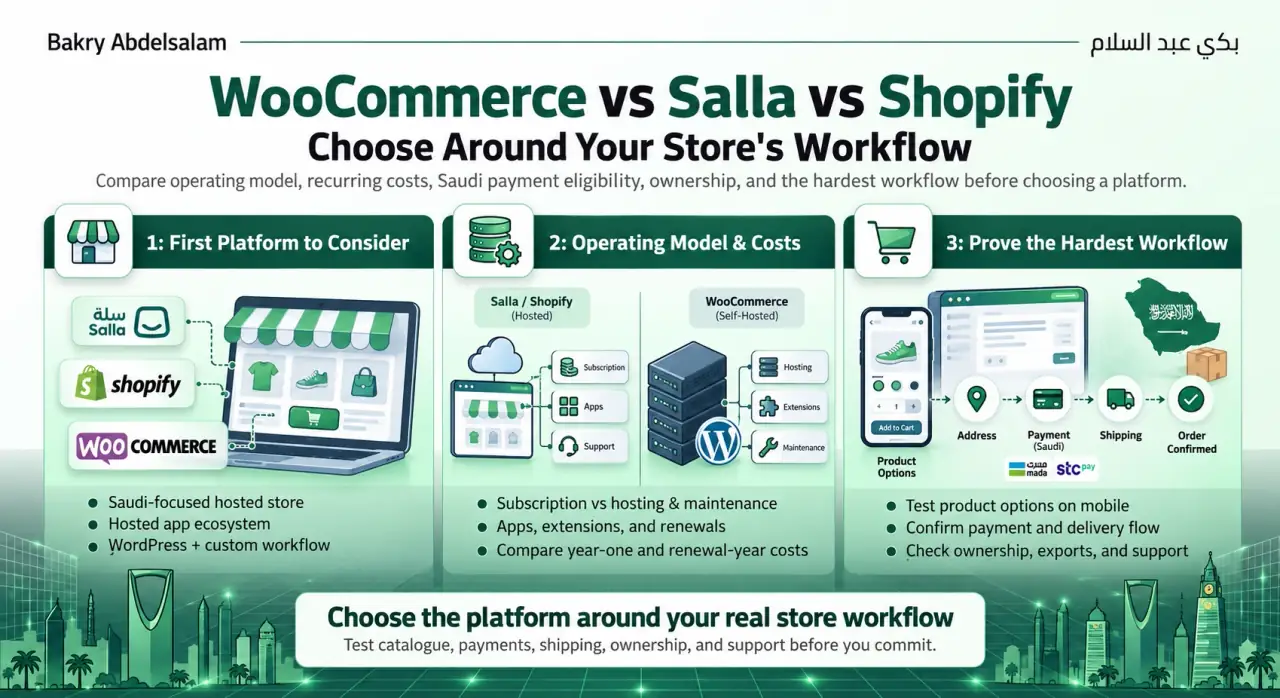
When comparing WooCommerce vs Salla, with Shopify as another hosted option, start with your catalogue and daily workflow. The right choice should make those tasks manageable—not persuade you to buy custom development you do not need.
This guide helps business owners serving Saudi Arabia compare scope, recurring costs and operating responsibility. Provider information was reviewed on 2 October 2026; confirm current plans and merchant eligibility before subscribing.
Which platform deserves your first look?
| Your situation | Consider first | Confirm before committing |
|---|---|---|
| A Saudi-focused store seeking hosted operations and Arabic administration | Salla | The plan and apps required for your exact payment, staff and design needs |
| A business seeking hosted commerce with an established app ecosystem | Shopify | Payment eligibility, operating countries, languages and total app costs |
| A store needing WordPress content and a defined custom product or operating workflow | WooCommerce | Build budget, hosting, maintenance and an accountable support provider |
| Unusual pricing, fulfilment or integration rules | Test the requirement on the candidate platform | A working demonstration and a clear maintenance scope |
Hosted does not mean every requirement is included. Customisable does not mean everything should be custom-built.
Compare the operating model, not just the feature count
WooCommerce is an open-source ecommerce platform for WordPress. The core software is free, while a working store still needs hosting, setup and continuing support. Extensions and external services can add recurring costs.
Shopify provides subscription-based hosted commerce. Salla also offers different plans, with features varying by tier. Verify the plan you will actually buy rather than assuming a demonstration uses entry-level functionality.
| Decision | WooCommerce | Shopify or Salla |
|---|---|---|
| Hosting responsibility | Your business or an agreed managed provider | The platform handles its hosted infrastructure |
| New functionality | Extensions or custom development, subject to compatibility and budget | Available platform features, apps and permitted customisation |
| Recurring costs | Hosting, licenses, support and provider fees | Subscription, apps, support scope and provider fees |
| Exit planning | Document files, database, rights and third-party dependencies | Verify exports and what must be rebuilt elsewhere |
| Search performance | Depends on useful content and sound implementation | Also depends on useful content and sound implementation |
Neither approach removes all responsibility. Product accuracy, fulfilment, account security and timely customer support still need an owner.
What does a year of operation really cost?
Ask for the same scope on each platform: the same products, variants, languages, delivery areas and integrations. Otherwise, the cheaper quote may simply omit more work.
Separate the estimate into:
- Design, setup, catalogue preparation and translation.
- Platform subscription or hosting, domain and renewals.
- Required apps, extensions and license renewals.
- Payment-processing charges and any applicable platform transaction fees.
- Maintenance, operational support and agreed content changes.
- Integration development, testing and recovery responsibilities.
A promotional subscription is not the store’s total budget. We do not publish a universal platform price here: billing period, region, taxes, offers and required add-ons can change the amount.
Use the Saudi website-development cost guide for scope questions, then the project brief template to make competing quotes comparable.
Confirm Saudi payment and shipping requirements early
A provider logo on a platform page is not approval for your merchant account. Establish the business-registration country, settlement currency, permitted activity, supported integration and account approval requirements.
For example, Shopify Payments eligibility depends on supported countries and business requirements. Where it is unavailable for your business, review an eligible third-party provider and the applicable fees.
For any platform, demonstrate the actual journey: choose a product option, enter a supported delivery address, see the final cost, complete a controlled payment test and verify the order. Ask how failed payments, refunds and unavailable delivery areas are handled. Integrations should be confirmed against current provider documentation and your account—not promised for every merchant.
A Raphia decision: make the product choice explicit
In Raphia’s bilingual coffee store, I organised discovery around coffee category and brewing method, with grind and weight choices in the purchase journey. WordPress and WooCommerce connect brand content with the catalogue.
For a similar store, test those choices before selecting the platform. Can a customer choose the required combination, see the price and continue on a phone in either language? Does the order show the information the fulfilment team needs?
Those are requirements, not reasons to insist on WooCommerce. A standard hosted feature may satisfy them. Custom work is justified when a verified requirement cannot be met sensibly within the existing tools.
This is an implementation example, not a claim that a particular platform increased sales.
A Ghazl decision: buying and custom enquiries are different tasks
Ghazl Saudi Arabia combines jewellery discovery with a custom-order enquiry route. A customer purchasing a listed item and someone discussing a custom requirement should not have to guess which action to take.
Write down which requests become orders and which become enquiries. Test both on the candidate platform. A late request for “a custom-order form” can change content, validation and team follow-up; include it in the original brief.
Does WooCommerce rank better than Salla or Shopify?
No platform name guarantees a ranking advantage. Review crawlable product and category pages, original content, internal links, metadata, canonical behaviour, image handling and mobile performance.
WooCommerce allows extensive technical customisation, but poor execution can waste that flexibility. Hosted platforms have their own tools and limits; check what your chosen plan exposes. Compare an actual product and category page, not a list of SEO claims.
The free AI website audit can help inspect public technical signals. It cannot prove your keyword rankings, qualified sales or private conversion rate without the relevant data.
Ownership and migration should be discussed before launch
Agree who controls the domain, provider accounts, approved content, customer data and delivered custom work. Account control is not the same as owning the platform’s software. File possession is not a substitute for clear rights and licenses.
Ask what products, orders, images and other records can be exported, in which formats, and what would require rebuilding. Existing indexed URLs, reviews, subscriptions and integrations may need separate planning.
Use the website ownership and handover guide to put those decisions in writing. For a WordPress hosting move, the migration checklist covers infrastructure, email and data cutover; a cross-platform rebuild needs an additional scope.
Before you choose: prove the hardest workflow
- Prepare product and variant counts, languages and required markets.
- Identify merchant accounts, shipping rules and external systems.
- Demonstrate one demanding product and a complete order on mobile.
- Confirm who edits content and who handles technical incidents.
- Compare renewal-year costs and support exclusions.
- Agree account control, export requirements and handover.
If WooCommerce is selected, include payment, order-state and email acceptance tests—not just a visual sign-off.
Frequently asked questions
Is Salla better than WooCommerce for a beginner?
A hosted service can be simpler when standard features meet the requirements and the business does not want hosting responsibility. WooCommerce is worth considering when WordPress or a defined custom workflow adds value and maintenance is covered.
Is WooCommerce completely free?
The core software is free, but a working store has development and operating costs. Include hosting, domains, extensions, payment services and support when comparing it with subscriptions.
Should I choose Shopify to sell internationally?
It may suit your needs, but verify business-country eligibility, payments, languages, currency and shipping. An international brand does not make every feature available to every account.
Can I move the store to another platform later?
A move can be scoped, but exports do not automatically preserve every function or indexed URL. Assess data, redirects, integrations and orders arriving during the transition before committing.
Share your catalogue before buying a platform
Send product and variant counts, required languages, selling markets, payment and shipping providers, and the workflow that needs special handling. Include the current URL if you already operate a store.
I can review the requirement and explain whether a standard hosted solution or WooCommerce development for Saudi businesses is an appropriate next step. A custom build should solve a defined problem, not be the default recommendation.