Your team copies approved requests into another system, manages member applications in a spreadsheet, or maintains a catalogue that ordinary blog fields cannot describe. The website is working, but an important part of the business still happens around it.
Custom WordPress plugin development is worth considering when a defined workflow needs behaviour that suitable existing tools cannot provide reliably. If an established plugin meets the requirement and your team can operate it, configuration or a small extension may be enough.
The useful first step is to demonstrate the hardest part of the workflow. This guide helps you decide what to commission, understand what drives the estimate and agree on evidence that the delivered function works.
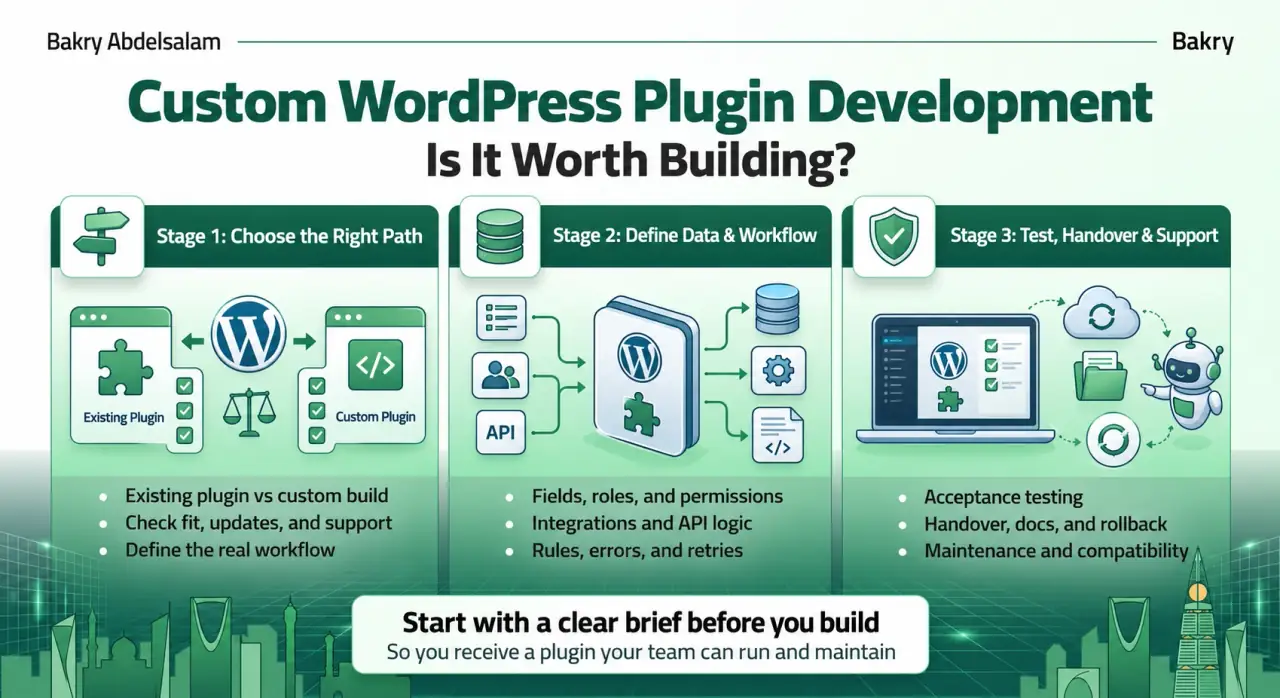
Should you configure, extend or build?
Describe the business action before choosing the implementation. “Connect our systems” leaves the scope open. “Send an approved application once, show failed transfers to the responsible employee and allow a controlled retry” gives the developer something concrete to investigate.
| Your requirement | Investigate first | Evidence to request |
|---|---|---|
| A common form or standard function | An established plugin | A demonstration using your required fields, users and settings |
| One missing behaviour in an otherwise suitable plugin | A supported extension | Confirmation that the change can survive updates without editing the original plugin files |
| Business-specific data, permissions or approval steps | A scoped custom plugin | Defined users, rules, outputs and acceptance scenarios |
| A connection to an external service | The provider’s API and your account access | Supported operations, limits and failure handling |
| A visual or speed problem | Diagnosis of the existing site | Evidence identifying where the change belongs |
Test a real requirement with safe sample data. Check administration, languages, export options, license renewal and support. A long feature list cannot tell you whether an employee can complete your particular task.
What belongs in a plugin rather than a theme?
A theme mainly controls presentation. A plugin adds functionality, such as a workflow, integration or specialised content structure. The WordPress Plugin Handbook explains how plugins extend WordPress without changing core files that updates can replace.
For the buyer, a useful question is whether the function should continue when the visual design changes. WordPress recommends registering custom content types in a plugin so that content remains portable across theme changes.
That does not require a new bespoke plugin for every field. Existing tools may provide the content model or settings you need. Ask where the function lives, what it depends on and what remains usable if the theme or a related component changes.
A project example: Simple Bio Links
I developed Simple Bio Links as a personal WordPress plugin project. Its documented scope includes public link pages, a front-end user dashboard, link scheduling and analytics. The Arabic case study describes the implementation.
One static page of links is a small requirement. Once different users manage their own pages, links appear at scheduled times and activity is recorded, the specification includes data, permissions and operating behaviour.
For a similar project, define who can create a page, what each user can edit, how scheduling behaves and which information the page owner needs. Those decisions make a proposal testable. This example describes my product work; it does not represent a client fee or a measured sales improvement.
A client example: model the content before choosing tools
For Arabookly’s Arabic book platform, the scope includes connected books, authors, classifications and catalogue fields, alongside search, reading lists and author submissions for review.
The starting questions concern the data: what identifies a book, how it relates to an author, which fields editors maintain and who can publish a submission. A screenshot cannot answer those questions or establish the implementation effort.
Arabookly demonstrates custom WordPress content and workflow development. It is not a claim that every feature was packaged as a separate plugin. If you need a directory, resource library or member portal, prepare representative records and their relationships before asking for a similar set of screens.
What affects custom WordPress plugin development cost?
A small field extension and a multi-role approval system have different workloads. A useful estimate should separate these parts:
- Rules and data: fields, relationships, validation and existing records that need migration or cleanup.
- Users and interfaces: administrator screens, front-end tasks and permissions for each role.
- External connections: API documentation, test access, usage limits, duplicate requests and failed transfers.
- The existing site: theme, relevant plugins, supported runtime versions and previous customisations.
- Acceptance and launch: test scenarios, deployment steps, documentation and recovery arrangements.
- Ongoing work: compatibility updates, provider changes and agreed support after delivery.
I estimate custom plugin work from the required behaviour and the current installation. If an integration or existing codebase has unresolved questions, a defined discovery step may be needed before a reliable implementation quote.
Provider fees, third-party licenses, hosting and continuing maintenance should have separate lines unless explicitly included. For the wider project budget, the freelance web developer cost guide explains how build scope, operating costs and client-side preparation fit together.
Give the developer a brief they can price
You do not need to write a technical specification. Answer seven practical questions:
- What does the team do today, and where does time or accuracy suffer?
- Who will use the function, and what may each person do?
- What data enters the process, where does it come from and where must it go?
- Which rules make a request valid, approved or rejected?
- What should happen if a connection fails or someone submits twice?
- Which existing plugins and external systems must it work with?
- Who will test and approve delivery, and what is the required launch window?
Here is an illustrative brief, not a description of an existing client implementation:
We receive membership applications in WordPress. An employee must review and approve each application before its data is sent to our external system. An application must not be sent twice. If transfer fails, the employee needs a visible status and a controlled retry. We need an Arabic interface and a record of the latest transfer outcome.
This establishes a trigger, a responsible user and a result. Before pricing it, the developer still needs to confirm the external system supports the required operation and agree which records should be stored and retained. Share anonymised samples for the initial discussion; access credentials and real customer data do not belong in the brief.
Use the website project brief template for the wider project details, then attach this function description.
Agree how the plugin will be accepted
Ask to review the function on staging with outcomes you can verify. In the example above, the acceptance set should include a valid application, missing data, an unauthorised user, a duplicate submission and an unavailable external service. Agree what the team sees and what it should do in each case.
The review should also cover the relevant theme and plugin combinations, Arabic and English interfaces where required, and the function’s effect on the pages that use it. WordPress’s secure plugin development guidance covers permissions, request checks and data handling. Implementation and technical review need a defined scope alongside the user-facing acceptance work.
At handover, request the agreed source files, installation and configuration notes, dependencies and licenses, test scenarios and an explanation of what happens to stored data on deactivation or removal. Confirm a recoverable backup and rollback steps before production deployment. The website ownership and handover guide covers the wider account and access discussion.
Who maintains a custom plugin after launch?
Agree which defects fall within the delivered scope and which changes need a new estimate. Name the person responsible for reviewing WordPress, WooCommerce and API changes, and explain how updates and documentation will reach the client.
Compare the build, continuing support and your team’s operating effort over a useful planning period. Custom development needs ongoing accountability; an existing plugin also needs a maintained source and an update process. The website maintenance service describes the kinds of responsibilities to put into the support agreement.
Frequently asked questions
Is a custom WordPress plugin always better than an existing plugin?
No. An established plugin can be sufficient when it meets the requirement, works with the site and has acceptable operating and support costs. Commission custom work for a defined gap that justifies the additional responsibility.
Do more plugins automatically make a WordPress site slower?
Plugin count alone does not establish performance. Review overlapping functions, loaded assets, database work and external requests. Measure the effect on the relevant pages before deciding what to replace.
How long does custom WordPress plugin development take?
The schedule depends on the rules, interfaces, integrations and acceptance work. Ask for reviewable milestones: approved scope, a working staging version, acceptance, then deployment and documentation. Provider access and client approvals should appear as dependencies.
Can another developer maintain the plugin later?
Clear code, documentation, dependencies and agreed access make that easier. Record usage and modification rights and any third-party restrictions in the agreement. A ZIP file alone does not explain how to operate or update the function.
Describe the function your WordPress site needs
Send your current URL, the task your team performs, who uses it and the outcome you need. I can assess whether an existing plugin, a limited extension or custom development is appropriate, then define the scope and acceptance steps with you.
Review the WordPress development service for the overall delivery scope. For a Saudi business, the Saudi WordPress service explains remote collaboration from Egypt, including custom themes, plugins and migration work.