The traffic report says people are visiting. Your inbox and WhatsApp tell a different story. Before you buy another campaign or commission a redesign, ask a smaller question: can a suitable visitor understand the offer, send an enquiry and receive a useful response?
Website traffic but no leads can mean several things. The visitors may be wrong for the service. The page may leave important questions unanswered. The form may fail to deliver. Or genuine enquiries may arrive without being recorded or followed up.
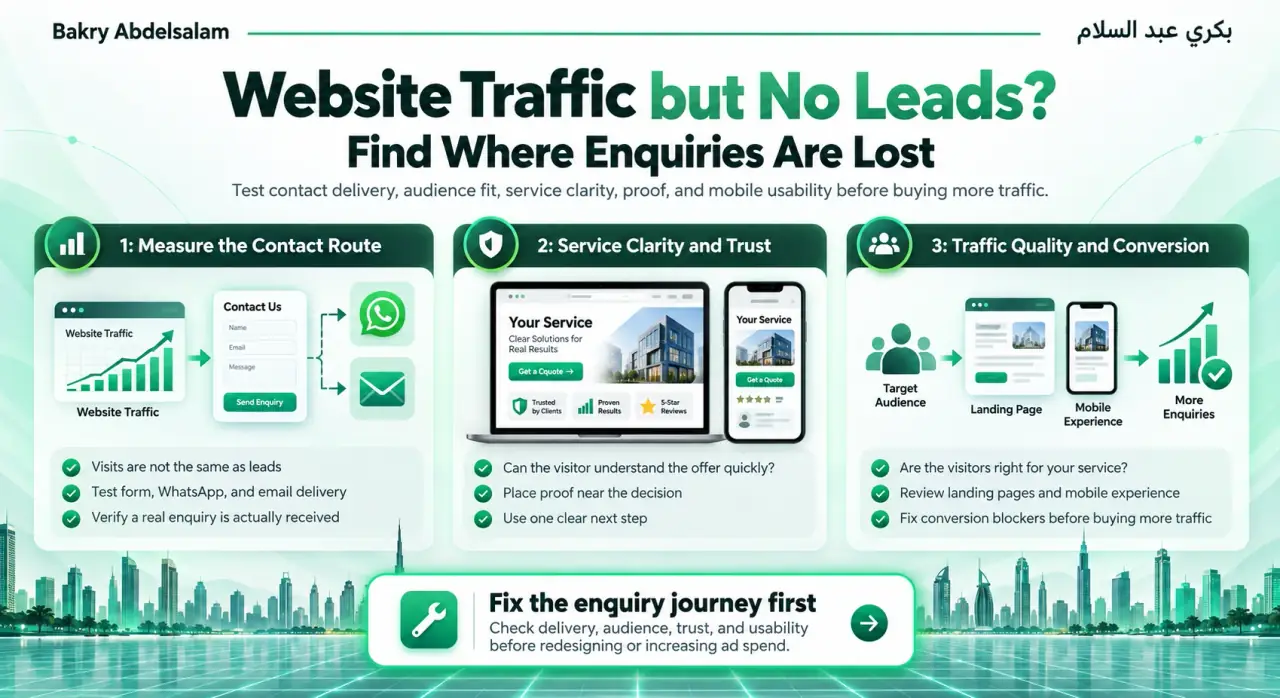
Start with one complete contact journey—from the landing page to receipt of the message. Then review audience fit, copy and proof. More visitors will not repair a broken route to your team.
Are there no enquiries, or is the measurement incomplete?
A form submission can reach the team while analytics misses it. A WhatsApp click can appear as a conversion even though the visitor never sends a message. Those are different problems and should not produce the same decision.
Separate the stages:
- Visit: someone reaches the page, possibly for a reason unrelated to your service.
- Contact attempt: they click a button or begin a form; no request has necessarily been sent.
- Received enquiry: your team actually receives a message or submission.
- Qualified enquiry: the person needs a service you offer and reasonably fits your scope.
A signed client is a further stage. Do not count every button click as a lead or every lead as a sale.
For a simple review, keep an internal record of actual requests: date, requested service, source or landing page when known, and whether the request fits. Do not attribute an enquiry to organic search without evidence. Keep personal customer information out of analytics events, and apply appropriate privacy and consent requirements when setting up tracking.
The fastest useful test: send a request from your phone
Open the priority service page on a phone using an ordinary connection. Follow the same route you expect a customer to use.
- Tap the primary contact action and confirm the destination makes sense.
- Enter clearly labelled test information. Leave a required field empty first to check whether the error helps you recover.
- Submit a valid request, check the confirmation and verify arrival in the intended inbox or request system, including the spam folder.
- Open WhatsApp, verify the number and prepared message, then send an actual test message. Opening the app does not prove delivery.
- Check email and phone links, and repeat the journey in the other language if the website is bilingual.
Record the exact failure. A success message with no received enquiry is an operational defect to investigate. It is not a reason to publish more content or spend more on traffic.
Are the visitors looking for what you sell?
A tutorial may attract people who want to solve a problem themselves. A service page may attract buyers comparing providers. A large audience for the first does not prove the second is reaching suitable customers.
Review entry pages, available Search Console queries, countries and devices. Ask whether those searches relate to a service you provide, and whether the destination answers the decision the visitor is making. Aggregate traffic cannot reveal every visitor’s intent, and search reports do not expose every query.
If a technical article attracts self-service readers, offer a relevant implementation step for those who need help. Do not turn the entire article into an advertisement. If visitors come from markets you cannot serve, clarify geography and delivery instead of treating every increase as progress.
For paid traffic, match the promise and destination. An advert for ecommerce development leading to a broad home page makes the visitor locate the offer again. Review the landing page before concluding that the campaign needs a bigger budget.
Can a buyer explain your offer after reading the opening?
“We create innovative digital solutions” sounds polished but does not tell a company owner whether you build service websites, stores or internal systems.
The opening of a service page should establish:
- Who the service is for and what problem it addresses.
- What is included, and what needs a separate agreement.
- What evidence supports your ability to deliver.
- What the visitor should do next and what happens afterwards.
“A company website that explains your services, shows relevant projects and accepts quote requests on mobile” is more concrete. It describes the delivery without promising a fixed number of clients.
You do not have to publish a single price for every project. You can still explain cost drivers, what a quote requires, how the work proceeds and what support covers. Hiding every useful detail behind “contact us for more” leaves the visitor with work that the page could have done.
An Arc Vision decision: explain the service system before asking for a project
For Arc Vision’s engineering website, the service disciplines needed to make sense together: reality capture, geomatics, BIM, design, fit-out and coordination.
I structured the site around the journey from reality to delivery, with a methodology, selected projects and a route to start a project. The decision was to make the offer understandable before the contact action—not simply to make the button larger.
For your company, show how a client’s need becomes an agreed delivery and where your responsibility sits. This is a first-hand implementation example; it is not an asserted conversion increase.
Put the right evidence beside the decision
Once the visitor understands the offer, the next question is often: “Can this team actually do it?” A row of logos at the bottom is not always enough to answer that.
Use a relevant project and explain your role, scope and implementation. For development work, a specific content or interface decision can be useful proof. Genuine testimonials can help when you have permission to use them; anonymous praise or invented totals cannot replace evidence.
Check that the provider’s name, contact details, agreement process and handover responsibilities are easy to find. A real project described precisely is more credible than an unsupported claim about hundreds of successful customers.
A Raphia decision: answer the choice question before the action
In Raphia’s coffee store, customers need to find suitable coffee, then choose weight and grind. I organised discovery around category and brewing method, with product options within the purchase journey.
For a service business, the equivalent is helping visitors choose the right service before asking them to request a quote. If you offer a new website, maintenance and speed optimisation, explain which situation each addresses. Do not force a prospect to solve that distinction inside a long form.
You do not need to copy a store’s layout. Identify the unanswered question that blocks the next step, then answer it where the decision happens.
Make the next step specific and easy to complete
Choose a primary action that fits the page: share project details, request a review of an existing page, or book a conversation when that process is actually available. WhatsApp can be an alternative, but a page should not present several competing demands at equal strength.
“Send your website link and the service you need” sets a clearer expectation than “Get started.” Do not advertise a free assessment or an instant reply unless that is an offer you genuinely provide.
Ask only for information needed for the next step. If a budget or full company profile is not necessary for the first reply, consider making it optional or requesting it later. Label required fields, make errors actionable and preserve entered information where possible after a failed submission.
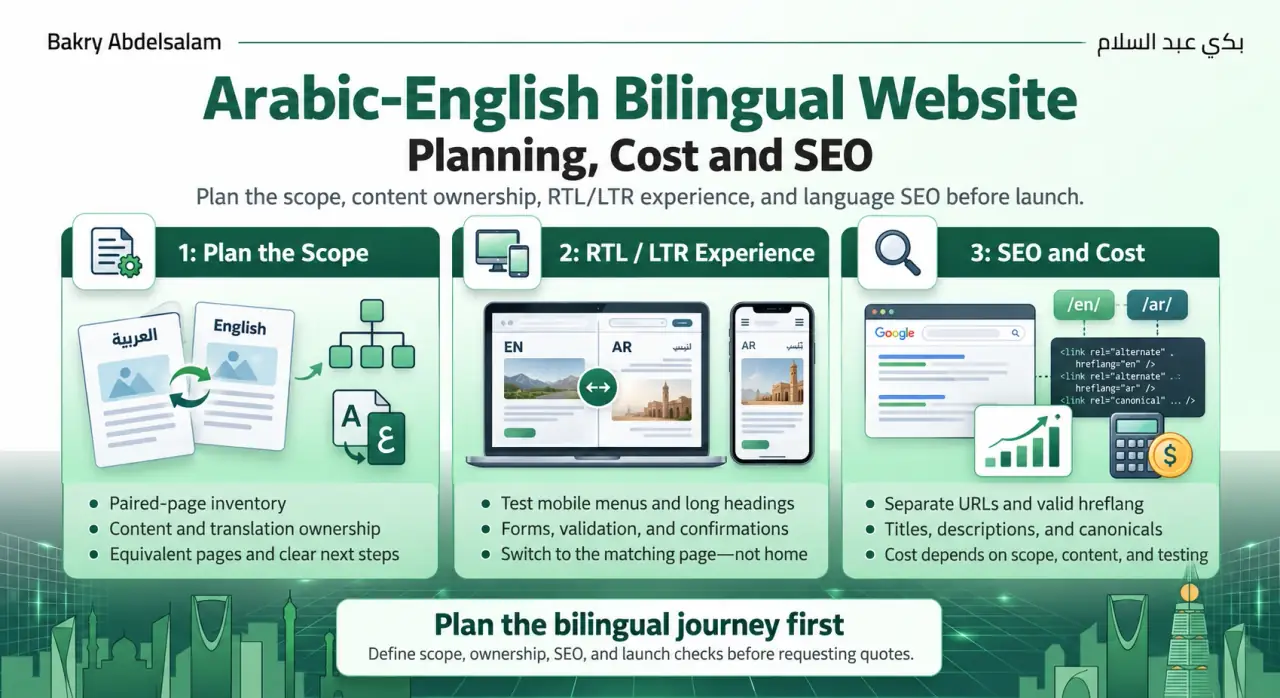
For bilingual pages, check the whole journey rather than only the headline. The Arabic-English bilingual website guide covers page pairing, translation responsibilities and contact checks in both languages.
What should you fix first?
Let the evidence determine the next action:
| What you found | A sensible first action |
|---|---|
| Wrong number, broken form or missing request delivery | Repair the contact route and repeat a real submission |
| Visits unrelated to your service or market | Review targeting, entry pages and their content |
| Suitable visitors cannot understand the scope | Improve the offer, boundaries, proof and next step |
| Long form or unusable mobile interaction | Remove task barriers and test on a phone |
| Received enquiries are not being followed up | Assign reception responsibility and review the response process |
If loading or display problems appear, use the AI website audit tool as a technical starting point. A public page inspection cannot see your conversations, private analytics or qualified-enquiry totals. It cannot, by itself, prove the conversion rate or why each visitor left.
Before commissioning a rebuild, define the defect and what should be preserved. The questions to ask a web developer will help you establish scope, verification and ownership instead of buying a visual change without an agreed outcome.
How will you know whether the improvement helped?
Record the date, page and problem addressed. Compare a suitable period before and after, considering traffic source, device and any campaign or seasonal changes. With only a few enquiries, a couple of days is too little evidence for a confident conclusion.
Where reliable measurement exists, compare received enquiries and their quality—not only button clicks. More irrelevant messages are not necessarily commercial progress, and missing tracking does not demonstrate that nobody contacted you.
Repair a confirmed fault promptly. Treat copy or layout changes as hypotheses to evaluate. Changing the offer, page structure and targeting every week makes it difficult to understand what affected the result.
Frequently asked questions
Will more traffic solve the lack of leads?
It may help when the visitors fit your service and the enquiry journey works. It will not repair a broken form or explain an unclear offer. Check delivery and audience fit before paying to attract more visitors.
Is a WhatsApp click a lead?
It is a contact-intent signal, not proof that a message was sent or that the visitor needs your service. Review actual conversations and qualified requests separately, respecting privacy.
What is a good conversion rate for a company website?
There is no universal figure. It depends on the service, market, traffic source and definition of conversion. Start with trustworthy measurement for your own site, then compare similar periods and enquiry quality.
Does this mean I need a full redesign?
Not necessarily. A form repair, service-page rewrite or mobile fix may be enough. A broader redesign is more appropriate when the defects affect the structure or experience widely, after diagnosis and a plan to protect existing pages and URLs.
Share the page that should generate enquiries
Send the service-page URL, the action you want visitors to take, your market and what happens today: no contact clicks, clicks without messages, or requests that do not fit. Please do not include customers’ personal information.
I can review the visible offer and contact journey, distinguish observable issues from questions that need private data, and scope implementation through my website design and development service. A new website should be a considered recommendation, not the automatic answer to a quiet inbox.